
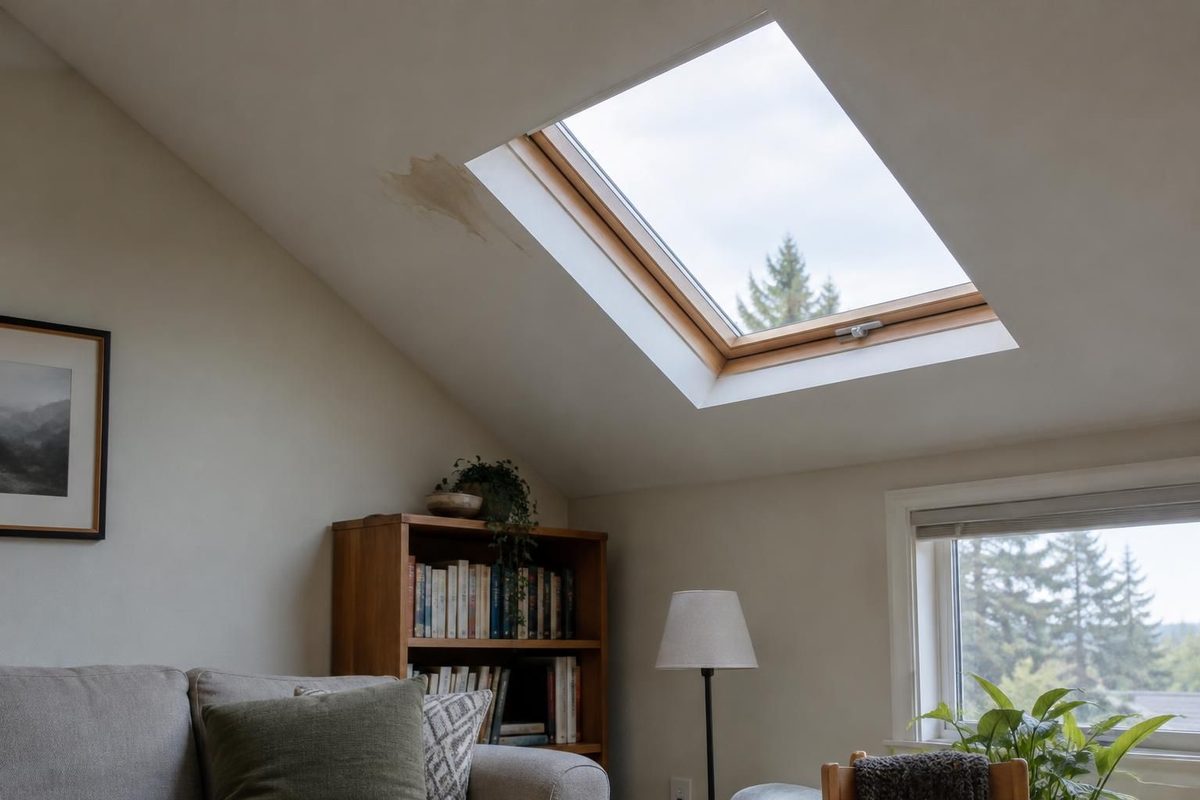
If a skylight leaks more than once, do not assume the glass or frame is the source. Water may enter at the unit, its flashing, or nearby roofing, then travel before appearing indoors. Note when the leak occurs and where moisture shows up, but treat those clues as observations—not a diagnosis. A roofer can assess the skylight and surrounding roof together to determine whether a focused repair is reasonable or a wider scope deserves discussion.
Why the skylight itself may not be the only source
Water visible beside a skylight does not establish where it entered. It can travel along framing or roof layers before reaching the interior, so the stain’s position is useful evidence but not a map of the leak. A roofer may need to trace possible paths from the opening outward.
The assessment should distinguish among the skylight unit, the flashing that connects it to the roof, and the surrounding roof covering. A problem at one interface can look much like a problem at another indoors. Avoid assuming that resealing the frame addresses the cause.
What conditions and timing can tell you
The pattern can help narrow the questions. Note whether water appears only during prolonged rain, during wind-driven rain, after a dry stretch, or at a particular point in the weather cycle. In Marin County, winter rain, wind exposure, nearby shade, and accumulated debris can affect how moisture reaches or persists around a roof opening, but conditions vary by property.
A leak that recurs after a previous repair deserves a fresh look at what was repaired and whether adjacent components were included. If the ceiling is bulging or sagging, keep people out of the area and seek appropriate professional assistance; do not puncture it. If water is near electrical equipment, keep clear and arrange qualified help.
What a qualified roofer should evaluate
A useful assessment considers whether the skylight is cracked, deteriorated, or otherwise compromised; how its flashing is integrated with the roof; and whether nearby roofing shows damage or openings. The roofer may also consider roof slope, water-shedding details, drainage, and signs that moisture has affected the surrounding materials. The right scope depends on what is accessible and observed.
Ask how the roofer will separate a unit issue from a flashing or roof-covering issue, and what evidence supports the proposed repair. If the source remains uncertain, ask what further assessment is needed rather than treating a tentative explanation as a confirmed diagnosis.
When a focused repair may be reasonable
A localized repair may make sense when assessment identifies a limited, accessible defect and the surrounding roof and skylight remain suitable for repair. A roofer might find, hypothetically, that a small area of flashing needs attention while the adjacent covering is serviceable. That example does not predict what an unseen roof needs.
Repeated leakage can also reflect a failing or poorly integrated unit, broader deterioration, or damage extending beyond the visible stain. In those cases, repairing one visible point may not address the underlying condition. Ask the roofer to explain the repair’s boundaries, what remains unchanged, and what findings would shift the recommendation toward replacing the skylight or addressing a wider roof area.
When to compare repair with replacement
Replacement may merit discussion if the skylight itself is deteriorated, compatible repair details are unavailable, or assessment finds related roof conditions that make a small fix unreliable. It is not automatic just because the unit is old or the leak has happened more than once. The condition of the roof around it and the scope of any necessary work matter too.
If replacement is proposed, ask whether the estimate includes the unit, flashing, adjacent roof work, and interior repair—or identifies those items as excluded. Confirm how the contractor will protect the opening during work and what assumptions affect the scope. For requirements that need current verification, consult the local building department or an appropriate professional.
What to note before a skylight repair appointment
- Record when the leak appears and whether it follows prolonged rain, wind-driven rain, or a dry period.
- From indoors, note the stain’s location, size, and any changes; take dated photos without touching a wet or sagging ceiling.
- Describe whether water seems to appear at the skylight frame, nearby ceiling, or farther down a wall, while treating the entry point as unconfirmed.
- Share the skylight’s approximate age, any available installation or repair records, and recent roof or exterior work.
- Ask the roofer to assess the skylight unit, its flashing, the surrounding roof surface, and possible water paths before defining repair scope.
Questions about this approach
Does a ceiling stain beside the skylight prove the skylight is leaking?
No. A stain’s location can be useful, but water may travel before becoming visible indoors. The roof opening, flashing, adjacent covering, and possible water paths need assessment before the entry point is established.
If a skylight leaked again after a repair, does it need replacement?
Not necessarily. Recurrence is a reason to review what the prior repair covered and reassess the unit, flashing, and nearby roof. A repeat leak alone does not establish that replacement is necessary.
For help applying this approach, explore our roof repair in San Rafael.
Talk with Able Roofing about your roof
Share the symptoms, property details and questions you want answered. Request a roofing estimate, email jon@ableroofing.biz, or call (415) 786-7308.