
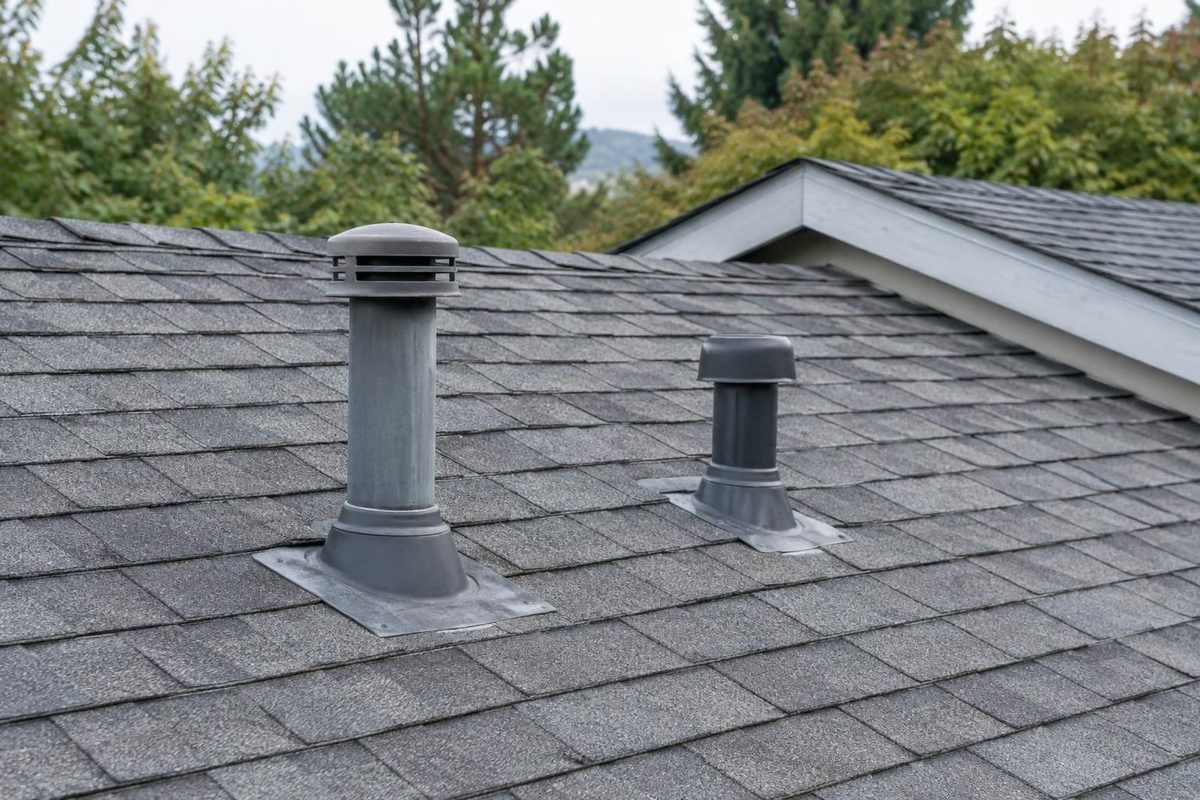
A complete roof replacement proposal should identify the roof penetrations that need work and explain what will happen to each one’s flashing. Vents, skylights, chimneys, and equipment curbs have different shapes and functions, so a general statement such as “replace roof” may not make the scope clear. Before approving work, ask which details are included, what will be reused or changed, and how unexpected conditions will be handled.
Why each penetration needs its own scope
A roof penetration is any opening or raised structure that passes through or interrupts the roof surface. Common examples include plumbing vent pipes, exhaust vents, skylights, chimneys, and curbs that support rooftop equipment. These details do not all use the same flashing or installation approach.
In a complete replacement, the roof covering is only one part of the system. Each penetration is also a place where water must be directed over and away from the roof opening. A proposal that says only “replace roof” may leave unclear what will happen at those interfaces. Ask for the relevant penetrations to be identified rather than assuming a general roofing line item covers every detail.
What a roofer should evaluate at each opening
A qualified roofer can assess the penetration’s type, position, surrounding roof material, existing flashing, and condition of nearby components. The review may also consider whether the penetration is stable, whether its size or configuration is changing, and whether another trade’s equipment or work affects the detail.
The appropriate solution depends on the whole roof assembly, the specific penetration, product instructions, and site conditions. For example, a plumbing vent and a broad equipment curb may need different flashing arrangements. This is why a single generic note may not communicate enough about the planned work.
What flashing language should make clear
Flashing is material shaped and installed to help manage water at transitions and openings. A proposal should make clear whether existing flashing will be replaced, reused, or altered, and identify the basis for that choice. Reuse may be considered in some circumstances, but it should not be assumed suitable simply because the surrounding roof covering is being renewed.
Ask how the flashing will connect to the chosen roof covering and the penetration itself. If a detail is not visible or its condition cannot be confirmed until work begins, ask how the contractor will document the finding, explain any proposed scope change, and obtain approval before proceeding.
Separate roof work from equipment changes
Some penetrations serve plumbing, ventilation, skylights, or mechanical equipment. Replacing a roof does not necessarily include replacing or relocating those items. If the proposal mentions a curb, vent, or skylight without saying what work is included, clarify whether the roofer will handle it or whether coordination with another trade is needed.
This distinction matters when equipment is aged, disconnected, scheduled for replacement, or installed by a separate contractor. Ask who is responsible for coordinating access and for making the final connection watertight after any equipment work. Avoid assuming that a roofing scope includes electrical, plumbing, or mechanical modifications unless the written proposal says so.
Read the scope for limits and unknowns
A useful proposal identifies the penetrations relevant to the property and describes the work planned at them in understandable terms. It should distinguish included tasks from exclusions and explain how concealed conditions will be handled. The contractor may not be able to confirm every hidden detail before the existing roof is opened, but the process for communicating discoveries can still be clear.
In San Rafael and elsewhere in Marin County, winter rain and wind-driven moisture can make sound water-management details important; shade, debris, and roof design also affect conditions at individual properties. Those factors do not establish that a particular penetration is defective. They are reasons to ask how the proposed details suit the actual roof rather than relying on a broad promise or a generic description.
When a targeted repair may be enough
A complete replacement is not automatically necessary because a vent or flashing detail needs attention. If the roof covering is otherwise in serviceable condition and the concern is limited to one penetration, a qualified roofer can assess whether a focused repair or further evaluation is appropriate. Conversely, repeated deterioration at several openings or broader roof concerns may affect the scope decision.
If you have noticed staining or a drip near a vent, share when it occurs and where it appears indoors, but do not treat the room location as proof of the entry point. Water can travel before becoming visible. A roofer’s assessment should consider the surrounding roof and other possible sources rather than diagnosing the cause from one symptom alone.
Before approving the replacement proposal
- Ask for each roof penetration to be identified by location and type, including plumbing vents, exhaust vents, skylights, chimneys, and equipment curbs where present.
- Confirm whether existing flashing will be replaced, reused, or modified at each penetration, and ask why that approach is appropriate.
- Ask how the proposal addresses the connection between the roof covering, flashing, and the penetration itself.
- Clarify whether any vent, curb, or equipment change is included, excluded, or dependent on another trade’s work.
- Request written notes for concealed conditions that could change the scope, including how the contractor will explain and document them.
- Keep a copy of the final scope and any approved changes with your roof records.
Questions about this approach
Can existing flashing be reused during a roof replacement?
Not necessarily. Whether existing flashing can remain depends on its type, condition, compatibility with the new roof assembly, and installation details. Ask the roofer to identify what will be reused and explain the reasoning for each relevant location.
Does a roof replacement include changing vent or equipment connections?
Not always. A roofer may be able to replace or adjust roofing details around an existing item, but changes to plumbing, electrical, or mechanical equipment may require the appropriate trade. Confirm responsibilities and coordination in writing before work begins.
What should I do if the roofer finds a problem after opening the roof?
Ask the contractor to note the location and type of the penetration, the condition observed, the recommended work, and any limits on what could be confirmed before work began. If an additional repair is proposed, request a written explanation and approval process.
For help applying this approach, explore our roofing services and materials.
Talk with Able Roofing about your roof
Share the symptoms, property details and questions you want answered. Request a roofing estimate, email jon@ableroofing.biz, or call (415) 786-7308.