
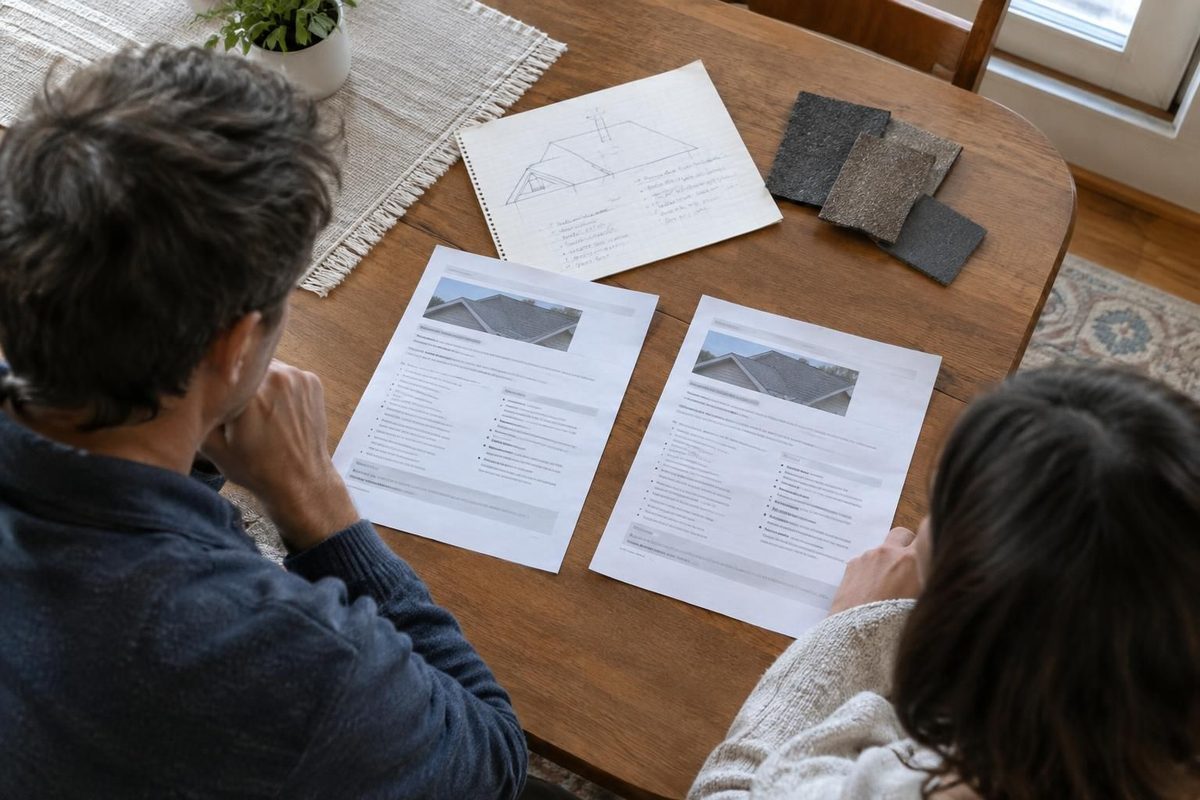
A clear roof repair estimate tells you where the roofer plans to work, what materials and components are included, and what falls outside the scope. It should also explain access assumptions and how concealed damage or a proposed change will be handled. If a line item says only “patch” or “stop leak,” ask for a specific written description before approving it; a proposal cannot diagnose an unseen roof by itself.
Separate the repair location from the symptom
A proposal should identify the area or component the roofer intends to address, not merely say “stop leak” or “patch roof.” A ceiling mark, damp wall, or drip can be some distance from where water enters, so a symptom alone does not establish a repair location.
Look for a description specific enough to distinguish the relevant roof area or feature—for example, a junction, roof opening, or drainage component. Ask what observation supports that location and whether nearby components will be checked. The roofer should explain uncertainty when the source cannot be confirmed before work begins.
Check what the stated work includes
Repair language can sound clear while leaving out the actual work. Ask what will be removed, replaced, resealed, or otherwise addressed, and which materials are included. Depending on the roof and suspected issue, relevant components could include the roof covering, flashing—the material that directs water at a joint or opening—or underlayment beneath the covering.
A proposal does not need to list every fastener to be useful, but it should make the intended repair understandable. If it names only a sealant or a generic patch, ask what condition that treatment addresses and whether the surrounding assembly will be evaluated. The appropriate scope depends on the roof’s material, condition, and configuration.
Clarify access, timing, and site assumptions
Access can affect how a repair is assessed and carried out. Ask whether the proposal assumes clear access to a particular roof area, whether indoor access or coordination is needed, and whether weather or other site conditions could delay or alter the work. In San Rafael, winter rain and wind-driven moisture can complicate scheduling or make observations less conclusive; conditions vary by property and season.
For a home with landscaping, an addition, or limited exterior access, describe the constraint before approving the scope. The roofer can say whether it affects the assessment or proposed approach. These are planning questions, not a reason to accept a repair whose location and purpose remain unclear.
Read exclusions and boundaries carefully
Exclusions define what the proposal does not cover. A repair may address one roof detail without including nearby flashing, gutters, interior finishes, or damage discovered beneath the visible surface. That boundary is not automatically a flaw; a limited repair may be sensible when the identified issue is localized. The important point is to understand what remains outside the work.
Ask whether the roofer will assess adjacent components and what happens if the initial repair does not explain the observed leak. Clarify whether any interior work is excluded and whether drainage concerns are part of the scope. A clear boundary helps you compare proposals without assuming two differently worded repairs cover the same work.
Set a process for concealed damage
Some conditions are not visible until roofing materials are opened. The proposal should explain how the roofer will handle that possibility: how findings will be documented, who will contact you, and whether additional work requires your approval before proceeding. Ask how a change in scope will be described and recorded.
This does not mean hidden damage is present or that every repair will uncover it. It is a practical decision point: you should understand the process before work starts, rather than trying to interpret an unexpected change on the spot. If the proposal is silent, request a written explanation of the communication and authorization process.
Compare clarity, not just line-item labels
When comparing proposals, place the location, included work, materials, access assumptions, exclusions, and concealed-damage process side by side. Different terms may describe similar work, while similar labels may conceal different boundaries. Ask each roofer to explain any difference in scope in plain language rather than choosing by a short label alone.
A small repair may be more appropriate than replacement when the concern is limited and the surrounding roof condition supports a targeted scope. Conversely, an estimate for a narrow patch cannot establish that broader work is unnecessary. If the proposal leaves the condition or extent uncertain, ask whether further assessment is warranted before deciding.
Before you approve a roof repair proposal
- Ask the roofer to identify the affected roof area and the evidence supporting the proposed repair, while recognizing that a visible stain may not mark the entry point.
- Confirm which materials and components are included, such as roofing pieces, flashing, underlayment, or drainage parts where relevant.
- Clarify access assumptions and any site conditions that could change the scope, including limited access or weather-dependent work.
- Ask what is excluded and whether related components will be assessed or left untouched.
- Agree on how concealed damage will be documented, communicated, and authorized before additional work proceeds.
- Request a written description of the repair and how completion will be reported.
Questions about this approach
Is a short repair estimate automatically a bad sign?
Not necessarily. A limited scope can be appropriate when it addresses a defined condition, but ask what evidence identifies that area, whether adjacent components will be assessed, and what remains excluded. A brief description is not proof that the repair is wrong; it is a reason to request clarification.
What if the roofer cannot confirm the leak source before work begins?
Ask the roofer to describe the unresolved question, what additional assessment could establish, and whether the proposed repair would be limited or conditional. Do not infer the source from a ceiling stain alone. If there is serious damage, sagging, or a safety concern, keep people away and seek appropriate professional or emergency assistance.
For help applying this approach, explore our roof repair in San Rafael.
Talk with Able Roofing about your roof
Share the symptoms, property details and questions you want answered. Request a roofing estimate, email jon@ableroofing.biz, or call (415) 786-7308.