
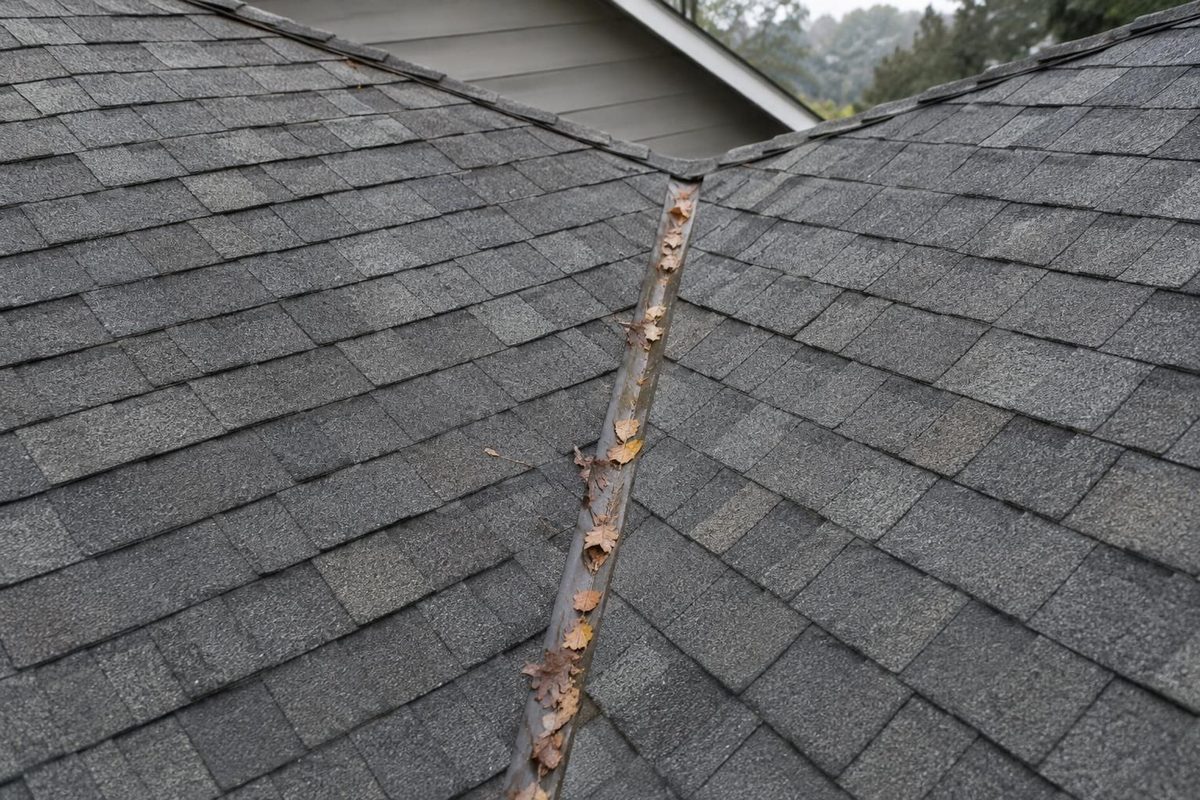
A leak that appears only after prolonged rain can point to a roof area handling sustained runoff, including a valley where two slopes meet. But water may travel before it becomes visible indoors, and a ceiling stain cannot identify its source by itself. Note when the leak occurs and what you can safely see from inside or from the ground; a roofer can then assess the valley, adjoining materials, and drainage before recommending a repair.
Why a valley can become a leak pathway
A roof valley is the junction where two sloping roof planes meet. It concentrates runoff from both planes into a narrower route, so sustained rain can send a substantial flow through that area. The valley itself is not necessarily defective: its performance depends on the roofing, the underlying water-shedding layers, and how the adjoining roof sections are integrated.
During a long storm, small weaknesses that stay unnoticed in lighter rain may become apparent. Water can also travel beneath or alongside roof materials before it shows indoors, so the visible ceiling mark does not establish the entry point. A stain below a valley makes that area worth discussing with a roofer, not a confirmed diagnosis.
What prolonged rain can reveal
Long-duration rainfall keeps roof surfaces wet and runoff moving for longer than a brief shower. Wind can push rain across the surface or toward roof details from an unusual direction. In San Rafael, local conditions vary by property; shade, nearby trees, wind exposure, roof shape, and drainage can all influence how quickly surfaces dry or where debris gathers.
A valley may also collect leaves or other debris, especially where trees overhang the roof. Material buildup can change how water moves, but visible debris alone does not prove it caused a leak. A roofer may consider whether water was diverted, whether the valley and adjacent materials are intact, and whether another nearby detail offers a more likely explanation.
Distinguish timing from source
The timing and pattern of a leak provide useful clues, but not a definitive answer. Note whether water appears only after hours of rain, during wind-driven rain, or during shorter showers as well. Record when the indoor symptom first appears, whether it stops after rain ends, and whether it recurs in the same location.
From a safe indoor location, observe the stain or drip without touching wet electrical fixtures or approaching a sagging ceiling. If the ceiling is bulging or sagging, keep people away and seek prompt professional assistance. Do not puncture it. If water is near electrical equipment, keep clear and contact an appropriate professional; do not handle equipment near water.
From the ground, you may be able to see whether a valley has obvious debris or whether roof materials appear displaced. A limited or blocked view is normal and is not a reason to climb up. Photos can preserve observations, but they cannot show hidden layers or determine where water entered.
What a roofer should assess
A qualified roofer can examine the valley and the materials that meet it, looking for conditions such as damaged or displaced roofing, deterioration, poor water shedding, or problems at adjoining details. The evaluation should account for the roof’s material and design rather than assume every valley is built the same way.
The assessment may also consider nearby penetrations, transitions, edges, and the roof area uphill from the indoor symptom. Water can move before appearing inside, while a stain may have a cause unrelated to the valley. Ask what evidence connects the suspected entry point to the symptom, and whether any areas could not be evaluated.
Drainage matters too. The roofer may consider whether debris, roof geometry, or a downstream drainage issue affects the flow path. This does not mean that a gutter or downspout is automatically responsible; it means the surrounding route for runoff belongs in the assessment.
Repair, monitoring, or broader work
A localized repair may be reasonable when an identifiable, limited defect is found and adjacent roofing and underlying conditions appear serviceable. Ask what specific component is affected, what the proposed scope addresses, and whether the repair depends on any assumptions about concealed materials.
Further assessment may be more appropriate if the suspected area is obscured, if the leak recurs after earlier work, or if the roofer sees broader deterioration or moisture concerns. Replacement is not established by the fact that a valley leaks during a long storm. The decision depends on the overall condition, the extent of the problem, and whether a durable, compatible repair is feasible.
For any proposed work, clarify how the roofer will evaluate related materials and what would prompt a change in scope. If additional damage is found, ask for an explanation and approval process before extra work proceeds. A clear diagnosis and bounded scope are more useful than a promise based on one symptom.
Prepare for the service visit
A concise record helps the roofer understand the pattern without substituting for an inspection. Include dates, rainfall timing as you observed it, affected rooms, and any safe ground-level view of the roof. Mention prior roof work or changes to nearby drainage, even if you are unsure whether they relate.
Keep people away from areas with active water near electrical equipment, significant ceiling sag, or other serious damage. For less urgent symptoms, arrange a professional assessment and avoid attempting roof access or temporary roof work yourself.
What to note before arranging an assessment
- Record when the leak appears and whether it follows prolonged rain, wind-driven rain, or both.
- From indoors, note the ceiling or wall location and whether the affected area changes over time.
- From the ground, note any visible valley debris, displaced roofing, or water spilling over an edge; do not climb to investigate.
- Take dated photos from safe, consistent viewpoints, including the indoor symptom and any visible exterior context.
- Tell the roofer about prior repairs, roof work, or drainage changes near the valley.
- Ask what parts of the valley and adjoining roof will be evaluated, and what findings would support repair rather than broader work.
Questions about this approach
Does a ceiling stain directly below a valley prove the valley is leaking?
Not necessarily. A stain below a valley is a useful clue, but water can travel beneath roofing or enter at a nearby detail. The roofer should assess the valley and surrounding roof rather than infer the source from the indoor location alone.
Should I clear leaves from the valley myself?
Do not climb onto the roof or try to clear the valley. Note what is visible from the ground and tell the roofer where debris appears to collect. A professional can determine whether access, clearing, or repair is appropriate and whether the buildup affected water flow.
Does a valley leak mean the whole roof needs replacement?
A single storm-related symptom does not establish that replacement is needed. Ask what defect was found, how extensive it is, and whether adjacent materials and underlying conditions appear serviceable. A limited repair or further assessment may be appropriate depending on those findings.
For help applying this approach, explore our roof repair in San Rafael.
Talk with Able Roofing about your roof
Share the symptoms, property details and questions you want answered. Request a roofing estimate, email jon@ableroofing.biz, or call (415) 786-7308.