
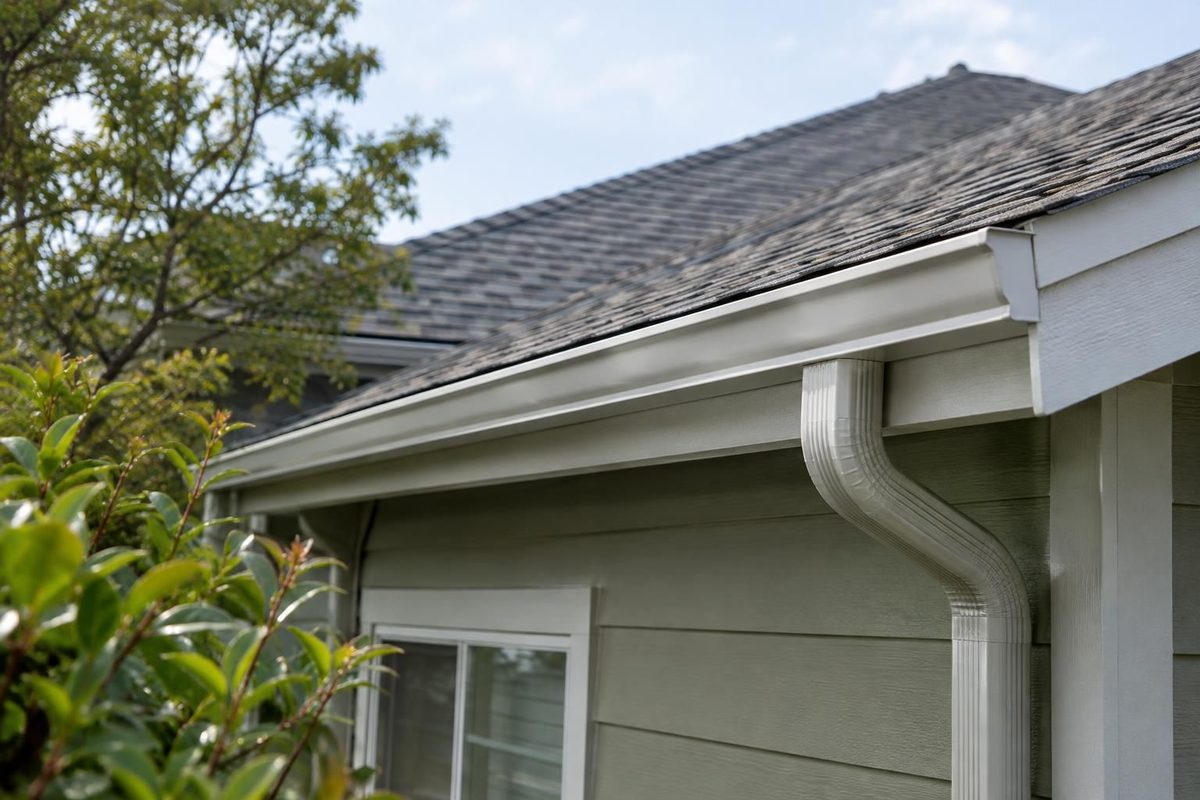
When planning a roof replacement, decide early whether existing gutters will stay, be removed and reinstalled, or be replaced. Ask the roofer and gutter contractor to coordinate the work order, clarify who handles the roof-edge connection, and identify where downspouts send runoff. Written scopes should assign each task and explain how newly uncovered damage will be handled. The right plan depends on the roof edge, gutter condition, and drainage layout.
Start by clarifying whether the existing gutters can stay
A roof replacement can affect gutter condition and attachment, but it does not automatically mean every gutter must be replaced. The roofer and gutter professional may need to consider the gutter’s condition, how it is fastened, the roof-edge design, and whether removal is needed to complete the planned work.
Ask whether the proposal assumes the gutters will remain in place, be temporarily removed and reinstalled, or be replaced. If reuse is proposed, clarify who will assess their condition and what happens if they are damaged or cannot be reattached as expected. The answer may depend on site conditions that are not visible before work begins.
Agree on sequence and responsibility before work is scheduled
Roofing and gutter work are connected at the eave, the lower edge of a sloped roof. A roofer may need access to that edge to complete the roof assembly, while a gutter installer may need to remove or adjust the gutter. If separate companies are involved, their schedules and scope should be coordinated rather than left to assumption.
Ask who will arrange the order of work, who will protect the exposed edge if the tasks happen on different days, and who should be contacted if one trade finds a condition that affects the other. A written division of responsibilities can prevent confusion about whether removal, temporary handling, reinstallation, or disposal is included.
Discuss how the gutter relates to the roof edge
The roof edge includes more than the visible shingle or tile. Edge metal, underlayment, fascia, and the gutter attachment can all influence how water sheds into the gutter and how the components meet. The exact arrangement varies with the roof system and existing conditions; a homeowner should not infer that a visible gap or overlap proves a defect.
Ask the roofer to explain the intended edge detail in plain language and how the gutter will be positioned relative to it. Also clarify whether the gutter installer will attach to existing fascia or whether any fascia repair or replacement is part of the plan. The two scopes should describe a compatible finished condition without requiring the homeowner to specify construction details.
Make runoff destination part of the same conversation
A gutter only collects water; the downspout and its discharge route determine where that water goes next. Before replacement, look from the ground for downspout outlets, visible extensions, and areas where water appears to collect after rain. Do not assume a new gutter will resolve drainage concerns if the downstream route is blocked, damaged, or poorly suited to the site.
Ask whether the planned work changes downspout locations or connections, and whether drainage beyond the outlet is included or handled separately. In Marin’s winter rainy season, runoff paths may become more apparent during sustained rain, but conditions differ by property. If water reaches a walkway, foundation area, or neighboring property, describe the observation and ask which professional should assess the route.
Know what could change once the old roof edge is exposed
Removing roofing or gutters can reveal deterioration that was not apparent beforehand, such as damage to fascia or other edge components. That possibility is a reason to agree on a decision process, not a reason to assume hidden damage exists. Ask how the contractor will document a newly exposed concern, explain its effect on the scope, and obtain approval before proceeding with added work.
If the gutter is retained, clarify how its condition and attachment will be handled if removal causes damage or reveals a problem. If replacement is planned, ask whether the estimate includes disposal and any related edge repairs, or identifies them as exclusions. Clear boundaries help distinguish necessary roof work from separate gutter or drainage work.
Use the estimate to check that both scopes fit together
When reviewing proposals from separate contractors, compare the assumptions rather than only the descriptions of materials. One proposal may assume gutters are removed by another trade; the other may assume they remain. Those assumptions can leave an unassigned task or an unexpected scheduling gap.
If a small repair to an existing gutter or attachment appears adequate, ask whether it can be handled separately from the roof replacement and whether it affects the planned roof-edge work. Replacement may be appropriate when condition or compatibility makes reuse unsuitable, but an unseen system cannot be judged from the proposal alone. For a San Rafael home, request a clear scope that identifies who handles each interface and runoff decision.
- Ask whether gutters will be removed, reused, replaced, or assessed separately.
- Confirm which contractor coordinates the sequence and temporary protection.
- Ask how the gutter attachment will meet the planned roof-edge detail.
- Check whether downspout changes and discharge routing are included.
- Clarify how concealed damage will be documented and approved.
- Compare exclusions and responsibilities across both written scopes.
Before approving a roof-and-gutter replacement plan
- Ask whether gutters will be removed, reused, replaced, or assessed separately.
- Clarify which contractor is responsible for coordinating the work sequence and protecting exposed edges if schedules differ.
- Confirm how the gutter attachment will relate to the planned roof-edge details.
- Review where each downspout will discharge and whether the outlet connects to an existing drainage route.
- Ask how changes to fascia or other concealed edge conditions will be reported and approved.
- Request a written description of which items are included in each contractor’s scope.
Questions about this approach
Do gutters always need to be replaced when a roof is replaced?
Not necessarily. Whether gutters can remain depends on their condition, attachment, and whether the planned roof-edge work can be completed with them in place. Ask the roofer to explain the project-specific constraint and whether removal and reinstallation are included or assigned to another contractor.
What if I am unsure where the downspouts discharge?
Describe what you can see from the ground, such as where an outlet ends or where runoff appears to collect after rain. Ask the contractor to identify whether the issue concerns the gutter, downspout, or drainage beyond the outlet, and which part of the work scope addresses it.
For help applying this approach, explore our roof replacement in San Rafael.
Talk with Able Roofing about your roof
Share the symptoms, property details and questions you want answered. Request a roofing estimate, email jon@ableroofing.biz, or call (415) 786-7308.