
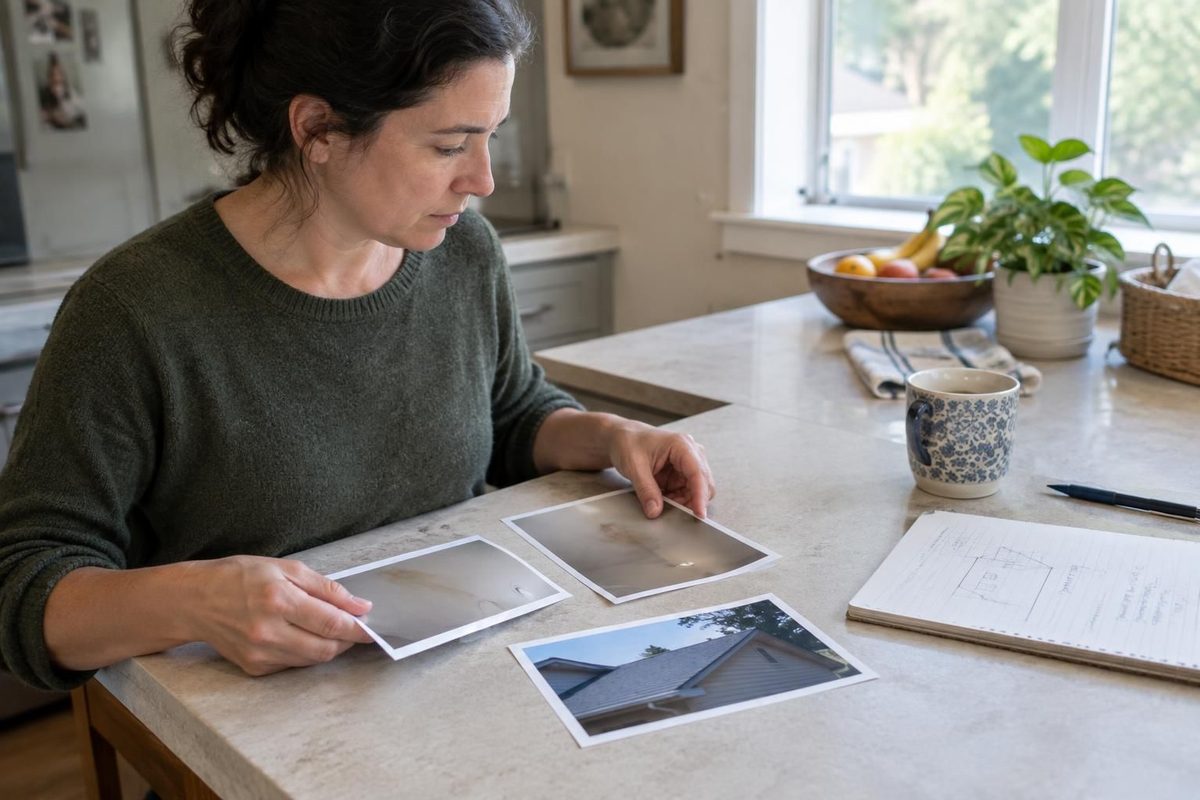
Before a roof service appointment, write down where the problem appears, when it changes, and what you can safely see. Take dated photos from indoors or the ground, and collect any records of prior roofing or nearby contractor work. Keep observations separate from guesses about the cause: a stain or drip does not identify its entry point. This preparation helps a roofer focus the assessment while leaving diagnosis to an on-site evaluation.
Make the location useful, not just the room name
“There is a stain in the bedroom” is a good start, but a roofer will need a more precise reference. Note which bedroom, where the mark sits in relation to a window or exterior wall, and whether it is on the ceiling, wall, or both. A quick room sketch can help if several spaces are involved.
If you can safely observe from indoors, note whether the area is damp, discolored, bubbling, or apparently dry. Do not press on a soft or sagging surface. If a ceiling is sagging, keep people away and seek appropriate professional or emergency assistance rather than approaching it to gather more detail.
Build a timeline without guessing at the cause
Timing may help distinguish among possibilities, but it does not diagnose the source. Record when you first noticed the concern, when you last saw it, and whether it changed after rain or wind-driven moisture. In Marin County, winter rain can make the timing of a new stain particularly useful; shade, fog, and debris may also be relevant depending on the building and roof.
Note what was happening around the same time: a storm, plumbing use, HVAC operation, or work by another contractor. Keep observations separate from theories. For example, write “stain appeared after overnight rain,” rather than “the valley is leaking,” unless a qualified professional has established that cause.
Take photographs that preserve context
Use a safe position indoors or on the ground. A useful set might include one wider photo showing the room and the affected area, followed by a closer image that shows the visible condition. If the concern can be observed from the ground outside, include a distant view that helps identify the general roof area. Never climb onto the roof for a better picture.
Keep the original images when possible, and note their dates. Take new images from roughly the same safe viewpoint if the condition changes. Photos can help describe what you observed, but they cannot show every concealed layer or prove where water entered. Avoid editing images in ways that could obscure the original condition.
Share known history and relevant limits
Gather whatever records are available, such as prior roofing invoices, inspection notes, or descriptions of earlier repairs. Approximate dates are useful when exact dates are unknown. Mention other work near the roof, such as a vent or equipment installation, but do not assume it caused the concern.
Let the scheduler or roofer know about practical constraints: which rooms are occupied, whether someone needs advance notice to provide access, or whether pets should be kept away from the work area. For a replacement discussion, share what you know about past roof work and any concerns about how the project may affect household routines. The roofer can explain what access and assessment are needed.
Ask for an assessment, not confirmation of a theory
At the appointment, show your notes and explain what is known versus uncertain. Ask what areas the roofer plans to evaluate and whether the visible issue could have more than one explanation. A water mark inside does not pinpoint a roof entry; moisture may travel before becoming visible, and plumbing or condensation may also warrant consideration.
For a possible replacement, ask whether the assessment is intended to identify a localized repair, broader deterioration, or conditions that require more investigation. A small, isolated concern may be more appropriate for repair or further assessment than replacement. Conversely, repeated symptoms or widespread concerns may call for a broader review. The decision should rest on the roof’s condition and the assessment, not one photograph or one symptom.
Use the appointment to agree on next steps
Before the visit ends, ask what was observed, what remains uncertain, and whether any additional information or assessment is needed. If work is proposed, make sure you understand the described area and scope before deciding. An appointment can clarify the next step without requiring an immediate replacement decision.
Keep your notes, photos, and any written findings together. If the concern changes before the appointment, update the timeline and capture a new safe-view image. If water is actively entering, or you notice electrical danger or serious damage, keep clear of the affected area and contact appropriate professional or emergency assistance rather than waiting to collect a complete record.
What to record before a roofing appointment
- Note the room or area where you noticed water, staining, or a change; identify the location as precisely as you safely can.
- Record when the issue first appeared and whether it followed rain, wind, fog, plumbing use, or another event.
- Take clear photos from a safe indoor or ground-level position, including a wider view and a closer view when possible.
- Describe changes over time, such as a stain growing, drying, or returning; do not assume the cause.
- List prior roof or ceiling work you know about, with approximate dates and any available paperwork.
- Tell the roofer about access limits, occupied rooms, pets, or other appointment considerations.
Questions about this approach
What if I cannot tell which part of the roof is above the stain?
Share any safe, dated photos you already have, plus the room location and timeline. If you cannot see the exterior roof area safely, do not try to access it; the roofer can explain how it will be evaluated.
Should I still report a stain if I do not know whether it is a roof leak?
Yes. A note that a stain appeared after rain is useful even if you are unsure whether it is roof-related. Tell the roofer what you observed and mention other plausible timing factors, such as plumbing use or HVAC operation.
Do my photos replace an inspection?
Keep the original photos and notes with any written assessment or scope. This creates a record of what was visible and discussed, but it does not replace a professional inspection or determine the cause by itself.
For help applying this approach, explore our roof replacement in San Rafael.
Talk with Able Roofing about your roof
Share the symptoms, property details and questions you want answered. Request a roofing estimate, email jon@ableroofing.biz, or call (415) 786-7308.