
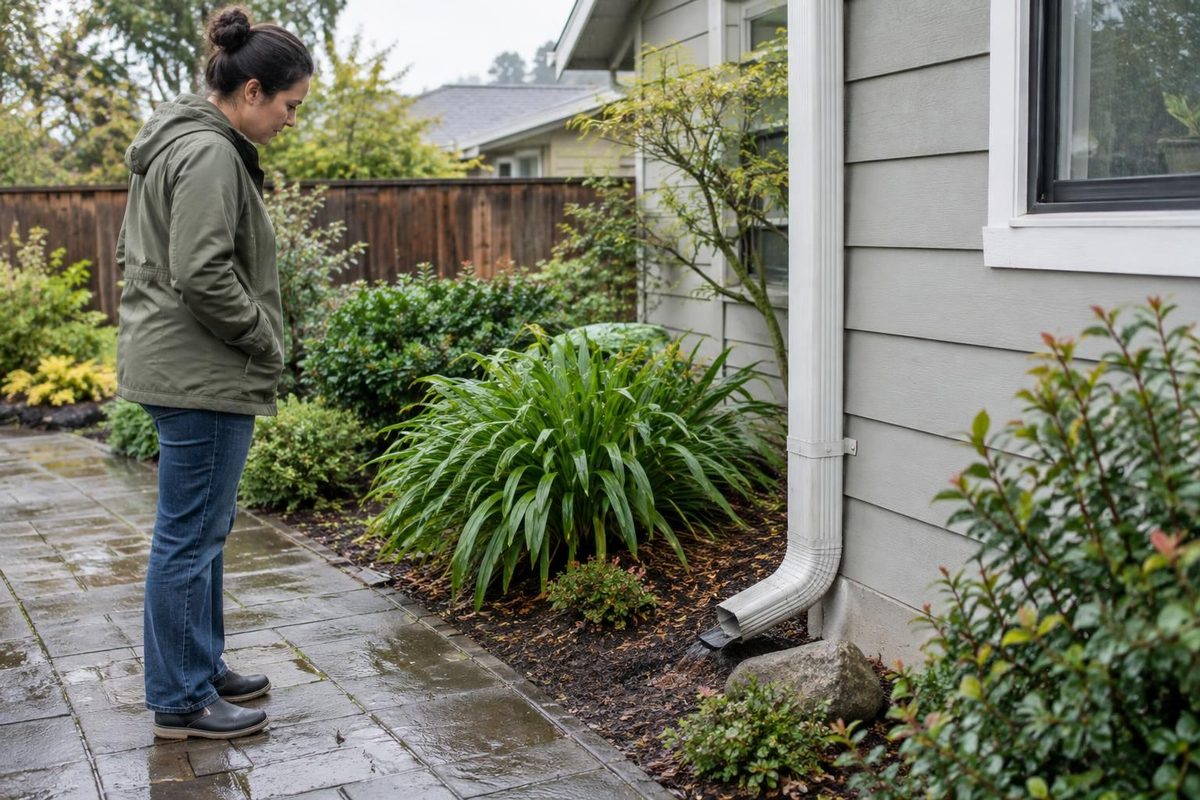
In a small Marin yard, a downspout can send roof runoff toward a walkway, planting bed, or low spot with little room for redirection. Start by watching from a safe ground-level location during or after rain: note where the outlet points, where water collects, and whether it seems to move toward the house. Those observations can help a roofer assess gutters and connections, while yard grading or discharge design may need a different professional.
Read the yard as a series of water destinations
A downspout is only one part of the runoff path. In a compact yard, its outlet may be near a planting bed, paved walkway, side passage, or the base of a slope. The useful question is not simply whether water leaves the gutter, but where it travels next and whether that route appears to keep it away from the home without creating another nuisance.
From a safe ground-level viewpoint, note the outlet’s direction and the surfaces nearby. Do not assume a damp patch proves the roof or gutter is at fault: irrigation, surface slope, soil, and other sources can also affect wetness.
Observe during and after rain, without approaching hazards
Marin’s winter rain can make runoff patterns easier to notice; wind may also push water or debris in ways that vary by storm and by building. Watch from a doorway or another stable, safe location. Look for water spilling over the gutter, a stream that appears to stop short of the outlet, splash marks, or persistent pooling. These are observations to share, not a diagnosis.
Do not climb a ladder or roof, reach into a gutter, or handle a downspout near electrical equipment or standing water. If water is close to electrical equipment, keep clear and contact an appropriate professional. If there is active flooding or a safety hazard, prioritize immediate assistance over documenting the flow.
Separate roof drainage from yard drainage questions
A roofer can assess roof edges, gutters, downspout connections, and visible signs that drainage components are blocked, damaged, or poorly connected. That assessment can help determine whether the roof-side system needs attention. It does not automatically establish how a yard should be graded or where an underground drain should discharge.
A small lot can have constraints such as narrow side yards, neighboring boundaries, paving, or limited planting space. If the outlet appears intact but water still gathers or moves toward the building, ask whether the concern calls for a drainage or landscape professional. Avoid assuming that extending a pipe or changing the discharge point is suitable; site conditions and local requirements may matter.
Give the roofer useful, bounded information
Photos taken from safe, repeatable viewpoints can make a conversation more precise. Include a wider view showing the downspout’s relationship to the house and a closer ground-level image of the outlet, if it is accessible without approaching a hazard. Note the date, whether it was raining, and how long afterward the area still looked wet. Keep observations factual: “water was visible at the corner” is more useful than deciding where it came from.
When arranging an inspection, explain whether you are seeing gutter overflow, a wet area near the foundation, or only a concern about where the outlet points. Ask what the roofer can evaluate as part of the visit and what would fall outside roofing work. That boundary helps prevent a roof inspection from being mistaken for a complete yard drainage design.
Compare possible next steps before authorizing work
If a gutter or connection is visibly damaged or obstructed, a focused repair or further assessment may be more appropriate than replacing roofing. If the roof-side components appear serviceable but yard water remains a concern, the next step may belong with a drainage specialist. A single wet patch, especially after one storm, is not enough to decide that either the roof or the yard needs major work.
Ask the roofer to explain the observation that supports any proposed roof-side repair, what component it addresses, and what remains uncertain. If the recommendation involves changes beyond gutters and downspouts, ask who should evaluate the site conditions and whether local requirements need to be checked with the relevant building department or professional.
Before discussing runoff with a roofer
- From the ground, note where each downspout ends and whether its outlet is visible.
- After rain, observe from a safe spot whether water flows freely, splashes back, or collects near the house.
- Record which areas stay wet longest, including planting beds, paths, and low spots.
- Check for visible debris or a disconnected section without climbing, reaching over hazards, or moving equipment.
- Take dated photos from the same safe viewpoints and note the weather conditions.
- Ask the roofer what roof and gutter conditions they will assess, and whether a drainage professional is needed for yard grading or discharge design.
Questions about this approach
Does a wet patch near the house mean the downspout is the problem?
No. A damp area can result from roof runoff, irrigation, soil conditions, or other sources. Note when it appears and what the downspout is doing, then ask a qualified professional to evaluate the relevant systems rather than inferring a cause from one symptom.
Can a roofer decide where an outlet should discharge in a small yard?
Not necessarily. A roofer can assess roof-edge drainage components and their visible connections, but yard grading, underground drainage, or discharge design may require another professional. Ask what the proposed work covers and who should evaluate issues outside the roof system.
For help applying this approach, explore our roof inspections.
Talk with Able Roofing about your roof
Share the symptoms, property details and questions you want answered. Request a roofing estimate, email jon@ableroofing.biz, or call (415) 786-7308.