
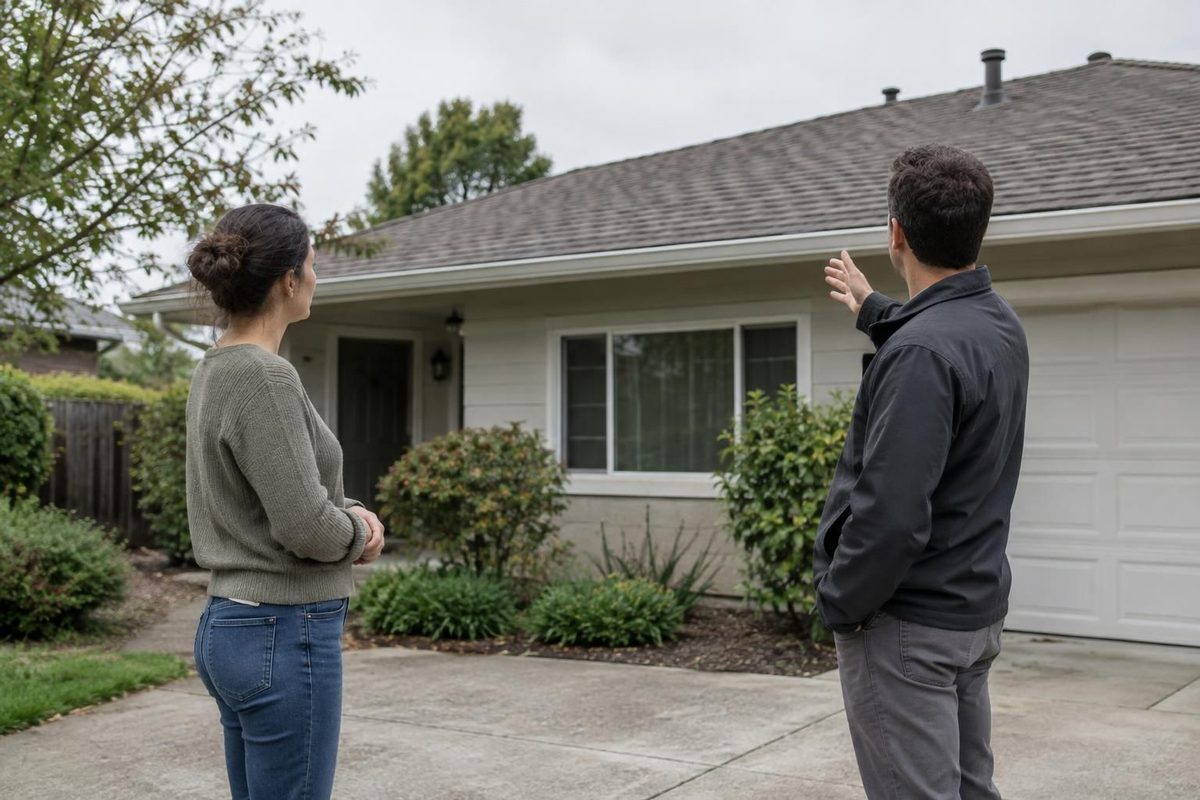
During a San Rafael roof inspection, ask the inspector to separate what they observed from what they infer, identify any areas they could not assess, and show the evidence behind a replacement recommendation. Then compare repair and replacement options by scope, not just price. A useful inspection should leave you with documented findings, stated limitations and clear next steps—not a diagnosis based on one symptom alone.
Separate visible conditions from conclusions
Ask the inspector to distinguish what they saw from what they infer. A report might document cracked or displaced roofing, worn surfaces, open joints, or moisture staining indoors. Those are observations. The explanation—such as water entering at a particular transition—may require further tracing and should be identified as a conclusion with supporting evidence.
A single ceiling stain does not establish that the roof needs replacement, or even prove where water entered. Roof leaks can travel before becoming visible inside. Ask what evidence connects the reported condition to the proposed work, and whether other possible sources were considered.
Request photographs or clearly labeled notes that identify the roof area and condition. If an issue is hidden or could not be examined, a sound report says so rather than presenting uncertainty as a confirmed defect.
Clarify inspection coverage and limits
A useful inspection explains its scope: which roof sections and related components were assessed, how they were viewed, and what could not be reached or evaluated. Some inspections rely on ground-level views, accessible roof surfaces, interior observations, or a combination; the approach depends on safety, roof design and conditions.
Ask whether the inspector checked transitions and penetrations—places such as edges, valleys, vents and where a roof meets a wall—as well as visible drainage components. These areas can be relevant to water entry, but an inspection does not guarantee that every concealed condition has been found.
In San Rafael, winter rain and wind-driven moisture can make water paths difficult to pinpoint. Shade, fog, nearby debris and drainage patterns may affect some properties, but none proves a particular roof defect. Ask which site-specific conditions matter to the findings and which are simply general considerations.
Test whether replacement is necessary now
A replacement recommendation should explain why repair alone may not be suitable. Ask whether the concern is isolated or repeated, whether the affected materials can be repaired compatibly, and what condition the remaining roof is in. A limited defect on an otherwise serviceable roof may call for repair or closer assessment rather than immediate replacement.
If deterioration is widespread, materials are failing in multiple areas, or prior repairs have not resolved recurring problems, replacement may be worth comparing with repair. The report should explain the evidence and tradeoffs without promising a particular remaining service life.
Ask what a repair would address—and what it would leave unchanged. For example, if a hypothetical roof has one damaged section but the rest appears sound, the relevant next question is whether a targeted repair is technically appropriate and what uncertainty remains. That example is not a diagnosis of any specific home.
Ask for quote evidence and a defined scope
A quote should connect findings to proposed work. Ask for the roof areas involved, the planned work sequence at a high level, and the materials or assembly components included. Clarify whether removal of existing roofing, underlayment, flashing, drainage details and debris handling are part of the scope or are addressed separately.
Ask how the contractor will handle conditions that cannot be confirmed until existing materials are removed. The written proposal should state how such findings will be documented, how any change in scope will be presented, and what approval is needed before additional work proceeds.
Compare proposals by scope, not just headline totals. Different assumptions about removal, repairs to concealed components, flashing or drainage can make two quotes difficult to compare. Ask each provider to identify exclusions and explain any material differences in the proposed work.
Use the appointment to establish next steps
Before the appointment, note when leaks or stains appeared, whether they change during or after rain, and any prior repairs. From a safe indoor location, take photos of visible staining or drips if conditions allow. Do not climb onto the roof, enter an unsafe attic, or handle electrical equipment near water.
During the discussion, ask when the written findings and quote will be available, what additional assessment may be needed, and whether any condition calls for prompt attention. If the ceiling is sagging, keep people away from the area and seek appropriate professional or emergency assistance; do not puncture it.
Afterward, check that the written report answers the questions you asked. If the recommendation remains unclear, request a specific explanation of the evidence, options and limitations before deciding.
Bring these questions to the inspection
- Which areas did you inspect, and were any parts inaccessible?
- What did you directly observe, and what remains a possible explanation rather than a confirmed cause?
- Can you show me the specific conditions behind the replacement recommendation?
- Which repairs could address the observed issues, and what limitations would remain?
- What work is included in the quote, including removal, underlayment, flashing, drainage and cleanup?
- What assumptions, exclusions or conditions could change the proposed scope?
Questions about this approach
What evidence should support a roof replacement quote?
Ask for the relevant roof area, the condition observed, and how it supports the proposed work. Request photos or notes, and have the contractor explain whether repair is feasible and what it would leave unresolved. If the explanation depends on a hidden condition, ask how that uncertainty will be assessed and documented.
Can an inspection confirm there are no hidden roof problems?
The report should state what was examined and what was inaccessible or concealed. Ask whether the inspector’s conclusion is confirmed, probable, or still uncertain, and what further assessment could clarify it. A visual inspection cannot establish every condition hidden beneath roofing materials.
Does one leak mean I need a new roof?
Not necessarily. If findings point to a localized, repairable issue and the surrounding roof condition is suitable, a targeted repair or further assessment may be more appropriate. Ask the roofer to compare the repair’s scope and limitations with replacement, using the observed condition of the roof rather than a single stain or leak as the basis.
For help applying this approach, explore our roof replacement in San Rafael.
Talk with Able Roofing about your roof
Share the symptoms, property details and questions you want answered. Request a roofing estimate, email jon@ableroofing.biz, or call (415) 786-7308.